Thrombotic events are dangerous blood clots that form inside blood vessels, including deep vein thrombosis (DVT), pulmonary embolism (PE), and stroke. They are caused by abnormal clotting when platelets aggregate and produce thromboxane, a substance that promotes clot formation. The AspirinWorks 11-Dehydrothromboxane B2 test is the most important test for monitoring aspirin effectiveness in preventing thrombotic events.
90-day money-back guaranteeLab order in minutesSave a trip to the doctorLow prices since 2005Labs within 2 miles
What causes thrombotic events?
Thrombotic events are caused by abnormal blood clot formation when platelets become overly sticky and aggregate together, producing thromboxane B2, a powerful substance that promotes clotting and constricts blood vessels. This process can be triggered by various factors including prolonged immobility, surgery, injury to blood vessels, inherited clotting disorders like Factor V Leiden, hormonal changes from pregnancy or birth control pills, and underlying conditions such as cancer or autoimmune diseases. The body normally maintains a delicate balance between clotting and anti-clotting factors, but when this balance is disrupted, dangerous clots can form in veins (like DVT) or arteries (leading to stroke or heart attack).
What is the best test for thrombotic events?
The AspirinWorks 11-Dehydrothromboxane B2 (11-dhTXB2) test is the most important test for monitoring thrombotic event risk because it specifically measures whether aspirin therapy is effectively preventing clot formation. This test detects 11-dhTXB2, a metabolite that indicates thromboxane production in your body. Thromboxane is the key substance that makes platelets stick together and form clots. When 11-dhTXB2 levels remain elevated despite taking aspirin, it reveals that your medication is not adequately suppressing clot formation, putting you at increased risk for DVT, pulmonary embolism, or stroke. The test includes creatinine measurement to ensure accurate interpretation based on kidney function, making it a comprehensive assessment of your antiplatelet therapy effectiveness.
When should I get tested for thrombotic events?
You should get tested if you are taking aspirin to prevent blood clots and want to ensure the medication is working effectively for you. Testing is especially important if you have a history of blood clots, stroke, heart attack, or have been prescribed aspirin therapy by your doctor. You should also consider testing if you have risk factors like prolonged bed rest after surgery, a family history of clotting disorders, take birth control pills or hormone replacement therapy, or have conditions like cancer or autoimmune disease. Getting tested helps verify that your aspirin is adequately suppressing thromboxane production and reducing your clot risk, rather than assuming the medication is working.
What are the symptoms of thrombotic events?
Symptoms vary depending on where the clot forms in your body. Deep vein thrombosis (DVT) typically causes leg swelling, pain or tenderness (often in the calf), warmth, and red or discolored skin in the affected area. Pulmonary embolism (PE) causes sudden shortness of breath, sharp chest pain that worsens with deep breathing, rapid heart rate, coughing up blood, and lightheadedness. Stroke symptoms include sudden numbness or weakness on one side of the body, confusion, trouble speaking or understanding speech, vision problems, severe headache, and loss of balance or coordination. If you experience any of these symptoms, seek emergency medical attention immediately, as thrombotic events can be life-threatening.
Who is at risk for thrombotic events?
People at increased risk include those over age 60, individuals who are overweight or obese, smokers, and anyone with prolonged immobility from long flights, bed rest, or sitting for extended periods. You are also at higher risk if you have had previous blood clots, have a family history of clotting disorders, are pregnant or recently gave birth, take birth control pills or hormone therapy, or have undergone recent surgery or experienced trauma. Medical conditions that increase risk include cancer, heart disease, inflammatory bowel disease, autoimmune disorders like lupus, and inherited clotting disorders such as Factor V Leiden or prothrombin gene mutation. People taking aspirin therapy should verify it is working effectively through testing.
What happens if thrombotic events are left untreated?
Untreated thrombotic events can lead to severe, life-threatening complications. A DVT can break loose and travel to the lungs, causing a pulmonary embolism that blocks blood flow and can be fatal. Pulmonary embolism can cause permanent lung damage, low oxygen levels, and strain on the heart leading to heart failure. Blood clots in arteries can cause stroke, resulting in permanent brain damage, paralysis, speech problems, or death. Untreated DVT can also lead to post-thrombotic syndrome, causing chronic leg pain, swelling, skin discoloration, and ulcers that may never fully heal. Early detection and treatment are critical to prevent these serious complications, which is why monitoring aspirin effectiveness through blood testing is so important for those at risk.
Can thrombotic events be diagnosed with a blood test?
Blood tests cannot directly diagnose active thrombotic events like DVT or pulmonary embolism, which require imaging studies such as ultrasound, CT scans, or venography. However, blood tests play a crucial role in assessing your risk of developing clots and monitoring the effectiveness of preventive treatments. The AspirinWorks test measures whether your aspirin therapy is adequately suppressing thromboxane production and platelet aggregation. D-dimer blood tests can help rule out active clots in certain situations. Blood tests can also identify inherited clotting disorders like Factor V Leiden, prothrombin mutations, and deficiencies in natural anticoagulant proteins. If you are on blood thinners, regular blood testing monitors medication levels to ensure proper dosing.
How are thrombotic events treated?
Treatment focuses on preventing the clot from growing, stopping new clots from forming, and reducing the risk of the clot breaking loose. Anticoagulant medications (blood thinners) like warfarin, heparin, or direct oral anticoagulants (DOACs) such as rivaroxaban or apixaban are the primary treatments. For severe cases, thrombolytic drugs may be used to dissolve clots quickly. Compression stockings help reduce leg swelling and prevent post-thrombotic syndrome after DVT. Some patients may need surgical procedures or catheter-based treatments to remove large clots. Long-term prevention often includes low-dose aspirin therapy, and the AspirinWorks test helps ensure this preventive treatment is working effectively. Treatment duration varies from three months to lifelong depending on your risk factors and whether the clot was provoked by a temporary condition.
How can I prevent thrombotic events?
Prevention strategies include staying physically active and avoiding prolonged sitting or bed rest. During long flights or car trips, get up and walk around every hour, do calf exercises, and stay well-hydrated. Maintain a healthy weight through diet and exercise, and quit smoking, as tobacco significantly increases clotting risk. If you are at high risk, your doctor may prescribe low-dose aspirin or anticoagulant medications, and you should verify aspirin effectiveness with the AspirinWorks test. Wear compression stockings if recommended, especially during travel or after surgery. Manage underlying conditions like diabetes, high blood pressure, and high cholesterol. Women at increased risk should discuss alternatives to estrogen-containing birth control pills or hormone therapy with their healthcare provider. After surgery, follow your doctor's recommendations for early mobilization and preventive medications.
What can I do at home for thrombotic events?
If you are at risk or recovering from a thrombotic event, stay well-hydrated by drinking plenty of water throughout the day, as dehydration thickens the blood. Keep your legs elevated when sitting or lying down to improve blood flow and reduce swelling. Perform regular ankle pumps and calf stretches to promote circulation, especially if you sit for long periods. Wear graduated compression stockings as recommended by your doctor to prevent blood pooling in the legs. Maintain a diet rich in omega-3 fatty acids from fish, along with plenty of fruits and vegetables. Avoid crossing your legs when sitting, and take frequent breaks to walk around during long periods of sitting. However, never stop prescribed blood thinners or aspirin without consulting your doctor, and use the AspirinWorks test to verify your aspirin therapy is working effectively.
How’s this work?
Getting your blood test with us is easy, private & backed by the power of science.
Long story short:
In the test options, use the filters or search box to narrow your choices and find the test you want.
If you need a hand navigating through options, text our super friendly support team at 754-799-7833, and we'll provide tailored suggestions to help you find the ideal test.
Once your order is placed, we’ll create your doctor’s lab order remotely, without any need for you to make a trip to a doctor in person or to talk to the doctor. Expect to receive your doctor’s lab order right in your inbox. It will also be in your patient portal if you need to find it later. We’ll also include instructions regarding fasting and other requirements for your test. Your patient portal will be auto-created hassle-free during checkout.
If this is your first time ordering, you'll be prompted to create a password for instant login access to your patient portal. It's a quick way to conveniently access your orders and results whenever you want.
When you’re ready, visit one of our 4,000 locations. Just bring your ID – no printing or faxing of your lab order is needed, as your order and details will already be in the lab system.
Note that most lab locations don’t accept walk-ins, so it’s best to book an appointment in advance. Don’t worry – we’ll provide detailed instructions along the way.
You’ll get your results via email & SMS and dive into understanding your body better. Yup, that easy!
If you have any questions, please text us at 754-799-7833 or email support@privatemdlabs.com and we'll gladly help you.
How do I know which test to get?
In the test options, find the test you want.
If you’re not sure which test to get, we can lend a hand in finding the right option.
Just text or call us at 754-799-7833, email us at support@privatemdlabs.com, and we'll gladly help you. We've got your back and reply quickly.
Is it possible to make changes to my lab order if I made a mistake with the name, date of birth, or any other details?
Absolutely! We totally understand that errors can happen. No worries, we're here to help you.
Just reach out to us via text at 754-799-7833 or shoot us an email at
support@privatemdlabs.com. Remember to include your order number and let us know the correct information you’d like to update.
Our awesome team will jump right in and make sure everything is sorted out and accurate for you.
There are no changes necessary if your address is wrong on the requisition though. We don’t mail anything out.
Our lab requires an address to be listed to generate an order.
Do you accept health insurance?
Only HSA & FSA is accepted.
Our services are strictly self-pay and cannot be submitted to your health insurance provider except for Health Savings Accounts or Flexible Savings Accounts.
This policy applies to all insurance companies, including federal health insurance programs like Medicare.
You can read more about our cancellation policy here.
How can I find a lab location near me?
During the ordering process, you’ll be able to select a specific lab near you, with no strings attached!
You can switch it up later easily and visit any of our authorized locations as long as it’s the same lab company you selected your test for (Quest Diagnostics or Labcorp).
Before you proceed with your order, feel free to browse through all our lab locations here. This will give you the peace of mind of knowing that there's a lab nearby your home, office or your favorite gym.
Here’s how easy it is to get blood work done on your terms
Order your testSave a trip to the doctor. Your results will come with clear, friendly explanations.Takes 2 minutes
Book an appointmentVisit any of our 4,000 nearby lab locations to have your samples collected.Book or walk-in
Get resultsReceive a clear, easy-to-digest health report by email & SMS within a few business days.Get answers, fast
Here’s why 1,000,000+ customers chose us for affordable hassle-free private blood testing.
You get clinical lab reports & simplified health insights.
Save time & gas, go straight to the lab. Our doctors cover the rest.
Results start landing the next day after your lab visit.*
We don’t sell or share your data. Your time & privacy matter.
US-licensed doctors have your back if things get unclear.
No hidden fees, nice discounts for regular checkups.
Save a trip to the doctor, go directly to the lab
Instant orders, results often overnight*
Results explained in simple language
Reviewed by US licensed doctors
Fast & confidential, we never sell or share your data
No insurance needed, transparent pricing
Demo results
Testosterone375 ng/dL
Demo results
NormalOptimal 400 - 1000High
375 ng/dL
What this means
Your testosterone levels are slightly below the optimal range. While this is not necessarily cause for concern, it may contribute to occasional fatigue, reduced motivation, or lower muscle mass over time.
Recommended actions
Increase resistance or strength training
Prioritize 7–8 hours of quality sleep per night, try to reduce stress
Include more zinc- and magnesium-rich foods (like shellfish, beef, pumpkin seeds, spinach)
Consider retesting in 3–6 months
* Regular blood test results (e.g., CBC) typically start arriving the next business day after sample collection. More complex tests, such as hormone panels, may take up to 10–15 business days due to their complexity.
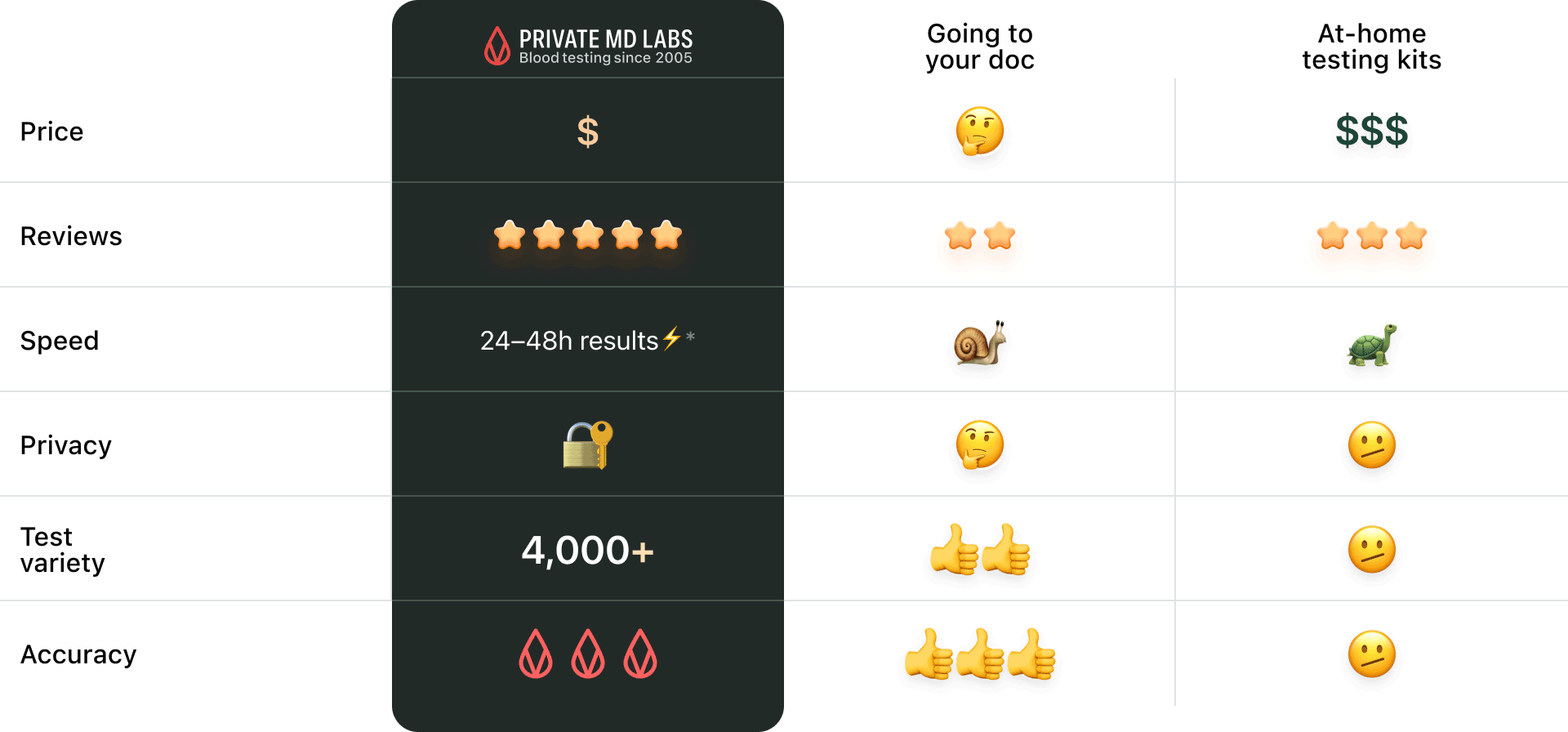
Us vs. Them
Not overhyped or overpriced. Just comprehensive blood testing made simple and for everyone.
* Regular blood test results (e.g., CBC) typically start arriving the next business day after sample collection. More complex tests, such as hormone panels, may take up to 10–15 business days due to their complexity.
1,000,000+ blood tests later, here's what our customers say
Estradiol Ultrasensitive results may get delayed due to high lab volume.It’s a nationwide delay affecting all labs (not just us). Standard processing times apply to all other tests in this panel.
Lipoprotein extended turnaround
Lipoprotein Fractionation, Ion Mobility results may get delayed due to high lab volume.It’s a nationwide delay affecting all labs (not just us). Standard processing times apply to all other tests in this panel.
Pregnenolone extended turnaround
Pregnenolone results may get delayed due to high lab volume.It’s a nationwide delay affecting all labs (not just us). Standard processing times apply to all other tests in this panel.



 90-day money-back guarantee
 Lab order in minutes
 Save a trip to the doctor
 Low prices since 2005
 Labs within 2 miles