Secondary hyperparathyroidism is a condition where the parathyroid glands produce excessive parathyroid hormone (PTH) to compensate for chronically low calcium levels in the blood. It is caused by vitamin D deficiency, chronic kidney disease, or malabsorption disorders that disrupt calcium metabolism. The Parathyroid Hormone (PTH), Intact test is the most important test for diagnosis because it directly measures elevated PTH levels.
90-day money-back guaranteeLab order in minutesSave a trip to the doctorLow prices since 2005Labs within 2 miles
What causes secondary hyperparathyroidism?
Secondary hyperparathyroidism is caused by chronic conditions that lower calcium levels in the blood, forcing the parathyroid glands to work overtime. The most common causes include chronic kidney disease, which impairs the kidneys' ability to activate vitamin D and regulate phosphorus, and vitamin D deficiency, which reduces calcium absorption from the intestines. Malabsorption disorders like celiac disease or Crohn's disease can also prevent adequate calcium absorption, triggering excessive PTH production as the body attempts to maintain normal calcium levels.
What is the best test for secondary hyperparathyroidism?
The Parathyroid Hormone (PTH), Intact test is the most important test for secondary hyperparathyroidism because it directly measures the level of parathyroid hormone in your blood. Elevated PTH levels confirm that your parathyroid glands are overproducing hormone in response to low calcium levels. Your doctor will typically order this test alongside calcium, phosphorus, and vitamin D tests to identify the underlying cause—whether it's kidney disease, vitamin D deficiency, or another condition affecting calcium metabolism. This comprehensive approach helps determine the most effective treatment strategy.
When should I get tested for secondary hyperparathyroidism?
You should get tested if you have chronic kidney disease, as this condition commonly leads to secondary hyperparathyroidism. Testing is also important if you experience bone pain, muscle weakness, or unexplained fatigue, which can indicate prolonged calcium imbalances. People with known vitamin D deficiency, a history of malabsorption disorders, or those taking medications that affect calcium metabolism should also consider testing to catch this condition early and prevent complications like bone disease.
What are the symptoms of secondary hyperparathyroidism?
Secondary hyperparathyroidism often develops gradually and may not cause noticeable symptoms initially. As the condition progresses, you might experience bone pain and tenderness, muscle weakness, fatigue, and joint discomfort. Some people develop itchy skin due to calcium-phosphorus imbalances. In advanced cases, particularly with chronic kidney disease, you may notice bone deformities or fractures because prolonged PTH elevation causes calcium to be pulled from the bones, weakening them over time.
Who is at risk for secondary hyperparathyroidism?
People with chronic kidney disease are at highest risk because kidney damage impairs vitamin D activation and phosphorus regulation. Those with vitamin D deficiency, whether from limited sun exposure, dark skin pigmentation, or inadequate dietary intake, face increased risk. People with malabsorption disorders such as celiac disease, inflammatory bowel disease, or those who have undergone gastric bypass surgery are also vulnerable. Additionally, elderly individuals and those taking certain medications like diuretics or bisphosphonates may develop this condition.
What happens if secondary hyperparathyroidism is left untreated?
Untreated secondary hyperparathyroidism can lead to serious complications affecting multiple body systems. The persistent elevation of PTH causes calcium to be stripped from your bones, leading to renal osteodystrophy—a bone disease characterized by pain, deformities, and increased fracture risk. You may develop cardiovascular problems including calcification of blood vessels and heart valves, increasing the risk of heart disease and stroke. Severe cases can progress to tertiary hyperparathyroidism, where the parathyroid glands become autonomously overactive and require surgical removal.
Can secondary hyperparathyroidism be diagnosed with a blood test?
Yes, secondary hyperparathyroidism is primarily diagnosed through blood tests. The Parathyroid Hormone (PTH), Intact test measures elevated PTH levels, which is the hallmark of this condition. Your doctor will also check your calcium levels (typically low or low-normal), phosphorus levels (often elevated, especially in kidney disease), and vitamin D levels (usually deficient). These blood tests together provide a complete picture of your parathyroid function and help identify the underlying cause driving the excessive hormone production.
How is secondary hyperparathyroidism treated?
Treatment focuses on addressing the underlying cause and restoring normal calcium and PTH levels. Vitamin D supplementation with active forms like calcitriol is commonly prescribed to improve calcium absorption. If you have chronic kidney disease, phosphate binders help control phosphorus levels, and calcimimetic medications can reduce PTH production directly. Dietary modifications including adequate calcium intake and limited phosphorus are important. In severe cases that don't respond to medical treatment, parathyroid surgery may be necessary, though this is less common than in primary hyperparathyroidism.
How can I prevent secondary hyperparathyroidism?
Prevention centers on maintaining healthy calcium and vitamin D levels. Ensure adequate vitamin D through sensible sun exposure, diet, or supplements, especially if you live in northern climates or have darker skin. Consume calcium-rich foods like dairy products, leafy greens, and fortified foods. If you have chronic kidney disease, work closely with your nephrologist to manage your condition and monitor your PTH levels regularly. Regular blood work to catch vitamin D deficiency or early kidney problems can help prevent secondary hyperparathyroidism from developing.
What can I do at home for secondary hyperparathyroidism?
While medical treatment is essential, several home strategies support your treatment plan. Take your prescribed vitamin D and calcium supplements consistently and at the recommended times. Maintain a balanced diet with adequate calcium but avoid excessive phosphorus from processed foods, sodas, and certain meats if you have kidney disease. Regular weight-bearing exercise like walking helps maintain bone strength. Get moderate sun exposure when possible to support natural vitamin D production. Keep all follow-up appointments and blood test schedules to monitor your PTH and calcium levels and adjust treatment as needed.
How’s this work?
Getting your blood test with us is easy, private & backed by the power of science.
Long story short:
In the test options, use the filters or search box to narrow your choices and find the test you want.
If you need a hand navigating through options, text our super friendly support team at 754-799-7833, and we'll provide tailored suggestions to help you find the ideal test.
Once your order is placed, we’ll create your doctor’s lab order remotely, without any need for you to make a trip to a doctor in person or to talk to the doctor. Expect to receive your doctor’s lab order right in your inbox. It will also be in your patient portal if you need to find it later. We’ll also include instructions regarding fasting and other requirements for your test. Your patient portal will be auto-created hassle-free during checkout.
If this is your first time ordering, you'll be prompted to create a password for instant login access to your patient portal. It's a quick way to conveniently access your orders and results whenever you want.
When you’re ready, visit one of our 4,000 locations. Just bring your ID – no printing or faxing of your lab order is needed, as your order and details will already be in the lab system.
Note that most lab locations don’t accept walk-ins, so it’s best to book an appointment in advance. Don’t worry – we’ll provide detailed instructions along the way.
You’ll get your results via email & SMS and dive into understanding your body better. Yup, that easy!
If you have any questions, please text us at 754-799-7833 or email support@privatemdlabs.com and we'll gladly help you.
How do I know which test to get?
In the test options, find the test you want.
If you’re not sure which test to get, we can lend a hand in finding the right option.
Just text or call us at 754-799-7833, email us at support@privatemdlabs.com, and we'll gladly help you. We've got your back and reply quickly.
Is it possible to make changes to my lab order if I made a mistake with the name, date of birth, or any other details?
Absolutely! We totally understand that errors can happen. No worries, we're here to help you.
Just reach out to us via text at 754-799-7833 or shoot us an email at
support@privatemdlabs.com. Remember to include your order number and let us know the correct information you’d like to update.
Our awesome team will jump right in and make sure everything is sorted out and accurate for you.
There are no changes necessary if your address is wrong on the requisition though. We don’t mail anything out.
Our lab requires an address to be listed to generate an order.
Do you accept health insurance?
Only HSA & FSA is accepted.
Our services are strictly self-pay and cannot be submitted to your health insurance provider except for Health Savings Accounts or Flexible Savings Accounts.
This policy applies to all insurance companies, including federal health insurance programs like Medicare.
You can read more about our cancellation policy here.
How can I find a lab location near me?
During the ordering process, you’ll be able to select a specific lab near you, with no strings attached!
You can switch it up later easily and visit any of our authorized locations as long as it’s the same lab company you selected your test for (Quest Diagnostics or Labcorp).
Before you proceed with your order, feel free to browse through all our lab locations here. This will give you the peace of mind of knowing that there's a lab nearby your home, office or your favorite gym.
Here’s how easy it is to get blood work done on your terms
Order your testSave a trip to the doctor. Your results will come with clear, friendly explanations.Takes 2 minutes
Book an appointmentVisit any of our 4,000 nearby lab locations to have your samples collected.Book or walk-in
Get resultsReceive a clear, easy-to-digest health report by email & SMS within a few business days.Get answers, fast
Here’s why 1,000,000+ customers chose us for affordable hassle-free private blood testing.
You get clinical lab reports & simplified health insights.
Save time & gas, go straight to the lab. Our doctors cover the rest.
Results start landing the next day after your lab visit.*
We don’t sell or share your data. Your time & privacy matter.
US-licensed doctors have your back if things get unclear.
No hidden fees, nice discounts for regular checkups.
Save a trip to the doctor, go directly to the lab
Instant orders, results often overnight*
Results explained in simple language
Reviewed by US licensed doctors
Fast & confidential, we never sell or share your data
No insurance needed, transparent pricing
Demo results
Testosterone375 ng/dL
Demo results
NormalOptimal 400 - 1000High
375 ng/dL
What this means
Your testosterone levels are slightly below the optimal range. While this is not necessarily cause for concern, it may contribute to occasional fatigue, reduced motivation, or lower muscle mass over time.
Recommended actions
Increase resistance or strength training
Prioritize 7–8 hours of quality sleep per night, try to reduce stress
Include more zinc- and magnesium-rich foods (like shellfish, beef, pumpkin seeds, spinach)
Consider retesting in 3–6 months
* Regular blood test results (e.g., CBC) typically start arriving the next business day after sample collection. More complex tests, such as hormone panels, may take up to 10–15 business days due to their complexity.
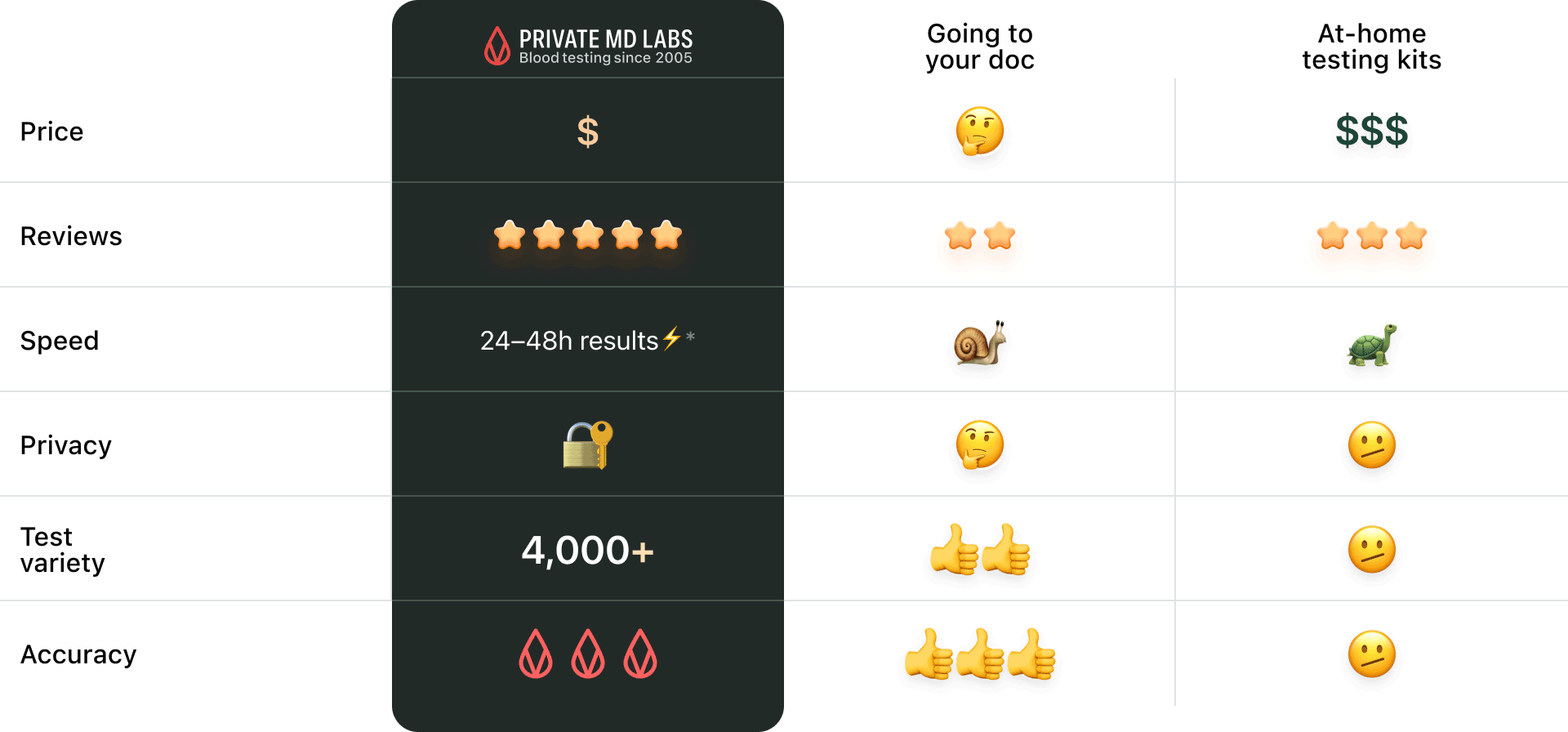
Us vs. Them
Not overhyped or overpriced. Just comprehensive blood testing made simple and for everyone.
* Regular blood test results (e.g., CBC) typically start arriving the next business day after sample collection. More complex tests, such as hormone panels, may take up to 10–15 business days due to their complexity.
1,000,000+ blood tests later, here's what our customers say
Estradiol Ultrasensitive results may get delayed due to high lab volume.It’s a nationwide delay affecting all labs (not just us). Standard processing times apply to all other tests in this panel.
Lipoprotein extended turnaround
Lipoprotein Fractionation, Ion Mobility results may get delayed due to high lab volume.It’s a nationwide delay affecting all labs (not just us). Standard processing times apply to all other tests in this panel.
Pregnenolone extended turnaround
Pregnenolone results may get delayed due to high lab volume.It’s a nationwide delay affecting all labs (not just us). Standard processing times apply to all other tests in this panel.



 90-day money-back guarantee
 Lab order in minutes
 Save a trip to the doctor
 Low prices since 2005
 Labs within 2 miles