Myasthenia Gravis (MuSK-related) is a chronic autoimmune neuromuscular disease that causes varying degrees of weakness in voluntary muscles. It is caused by antibodies that attack muscle-specific kinase (MuSK), a protein essential for nerve-muscle communication at the neuromuscular junction. The MuSK and LRP4 Antibodies Panel is the most important test for diagnosing this specific autoimmune subtype.
90-day money-back guaranteeLab order in minutesSave a trip to the doctorLow prices since 2005Labs within 2 miles
What causes Myasthenia Gravis (MuSK-related)?
MuSK-related Myasthenia Gravis is caused by autoantibodies that attack muscle-specific kinase (MuSK), a critical protein at the neuromuscular junction where nerves communicate with muscles. When these antibodies bind to MuSK, they prevent the proper clustering of acetylcholine receptors, which are essential for transmitting nerve signals to muscles. This disruption blocks the normal communication between your nerves and muscles, leading to progressive muscle weakness and fatigue that worsens with activity and improves with rest.
What is the best test for Myasthenia Gravis (MuSK-related)?
The MuSK and LRP4 Antibodies Panel is the most important test for MuSK-related Myasthenia Gravis because it specifically detects antibodies against muscle-specific kinase (MuSK) and LDL receptor-related protein 4 (LRP4) in your blood. This test is essential for confirming the diagnosis and distinguishing MuSK-positive Myasthenia Gravis from other subtypes, which is crucial because MuSK-positive patients often respond differently to certain treatments compared to other forms of the disease. A positive MuSK antibody result definitively confirms this specific autoimmune subtype and helps your healthcare provider select the most appropriate treatment approach for your condition.
When should I get tested for Myasthenia Gravis (MuSK-related)?
You should get tested if you experience progressive muscle weakness that worsens with activity and improves with rest, difficulty swallowing or chewing food, drooping eyelids or double vision, weakness in your arms or legs that makes daily tasks challenging, or difficulty breathing or shortness of breath. Testing is especially important if these symptoms fluctuate throughout the day, typically worsening in the evening or after repeated muscle use. Early diagnosis through antibody testing is critical because MuSK-related Myasthenia Gravis requires specific treatment approaches that differ from other forms of the disease.
What are the symptoms of Myasthenia Gravis (MuSK-related)?
The hallmark symptoms include muscle weakness that worsens with activity and improves with rest, drooping eyelids (ptosis), double vision (diplopia), difficulty swallowing (dysphagia), problems chewing food, slurred speech, facial muscle weakness, arm and leg weakness affecting daily activities like climbing stairs or lifting objects, and breathing difficulties in severe cases. MuSK-positive patients often experience more prominent bulbar symptoms like difficulty swallowing and speaking, along with neck and shoulder weakness, compared to other Myasthenia Gravis subtypes.
Who is at risk for Myasthenia Gravis (MuSK-related)?
MuSK-related Myasthenia Gravis affects women more frequently than men, with onset typically occurring between ages 20 and 40, though it can develop at any age. People with other autoimmune conditions like thyroid disease, rheumatoid arthritis, or lupus have a higher risk. This subtype represents approximately 5-10% of all Myasthenia Gravis cases and has a genetic component, meaning having a family history of autoimmune diseases may increase your susceptibility.
What happens if Myasthenia Gravis (MuSK-related) is left untreated?
Untreated MuSK-related Myasthenia Gravis can lead to severe and potentially life-threatening complications. The muscle weakness progressively worsens, making it difficult to perform basic daily activities like eating, walking, or caring for yourself. A myasthenic crisis can occur, where breathing muscles become so weak that you require mechanical ventilation to survive. Chronic swallowing difficulties increase the risk of aspiration pneumonia, where food or liquid enters your lungs. Without proper treatment, the progressive weakness significantly impacts quality of life and can be fatal if respiratory muscles become severely compromised.
Can Myasthenia Gravis (MuSK-related) be diagnosed with a blood test?
Yes, MuSK-related Myasthenia Gravis is diagnosed primarily through blood testing that detects specific antibodies. The MuSK and LRP4 Antibodies Panel measures the presence of antibodies against muscle-specific kinase and LRP4 proteins in your bloodstream. A positive result for MuSK antibodies confirms this specific subtype of Myasthenia Gravis. Your doctor may also perform additional tests like electromyography (EMG) or a repetitive nerve stimulation test to assess muscle and nerve function, but the antibody blood test is the definitive diagnostic tool for confirming MuSK-related disease.
How is Myasthenia Gravis (MuSK-related) treated?
MuSK-positive Myasthenia Gravis requires specific treatment approaches that differ from other subtypes. Immunosuppressive medications like corticosteroids, azathioprine, or mycophenolate mofetil are typically used to suppress the autoimmune response. Plasma exchange (plasmapheresis) and intravenous immunoglobulin (IVIG) therapy can provide rapid improvement during severe episodes. Notably, MuSK-positive patients often do not respond well to acetylcholinesterase inhibitors like pyridostigmine, which are commonly effective in other forms of Myasthenia Gravis, making accurate diagnosis through antibody testing essential for selecting the right treatment. Some patients may benefit from the medication rituximab, which targets specific immune cells.
How can I prevent Myasthenia Gravis (MuSK-related)?
Since MuSK-related Myasthenia Gravis is an autoimmune condition, there is no known way to prevent its initial development. However, once diagnosed, you can prevent symptom flare-ups and disease progression by following your treatment plan consistently, avoiding known triggers like infections, stress, extreme temperatures, and certain medications that can worsen muscle weakness. Maintain regular follow-up appointments with your healthcare provider to monitor antibody levels and adjust treatment as needed. Getting adequate rest, managing stress through relaxation techniques, and avoiding overexertion can help keep symptoms under control and prevent myasthenic crises.
What can I do at home for Myasthenia Gravis (MuSK-related)?
At home, prioritize rest and pace your activities throughout the day to avoid overexertion, as muscle weakness worsens with sustained use. Schedule important tasks for morning hours when you typically have more energy. Use assistive devices like walkers, grab bars, or eating utensils with larger handles to reduce strain. Eat smaller, more frequent meals with soft foods if swallowing is difficult, and sit upright while eating to prevent choking. Stay cool, as heat can worsen symptoms, and practice stress-reduction techniques like meditation or gentle yoga. Always keep emergency contact information readily available in case of sudden breathing difficulties or a myasthenic crisis.
How’s this work?
Getting your blood test with us is easy, private & backed by the power of science.
Long story short:
In the test options, use the filters or search box to narrow your choices and find the test you want.
If you need a hand navigating through options, text our super friendly support team at 754-799-7833, and we'll provide tailored suggestions to help you find the ideal test.
Once your order is placed, we’ll create your doctor’s lab order remotely, without any need for you to make a trip to a doctor in person or to talk to the doctor. Expect to receive your doctor’s lab order right in your inbox. It will also be in your patient portal if you need to find it later. We’ll also include instructions regarding fasting and other requirements for your test. Your patient portal will be auto-created hassle-free during checkout.
If this is your first time ordering, you'll be prompted to create a password for instant login access to your patient portal. It's a quick way to conveniently access your orders and results whenever you want.
When you’re ready, visit one of our 4,000 locations. Just bring your ID – no printing or faxing of your lab order is needed, as your order and details will already be in the lab system.
Note that most lab locations don’t accept walk-ins, so it’s best to book an appointment in advance. Don’t worry – we’ll provide detailed instructions along the way.
You’ll get your results via email & SMS and dive into understanding your body better. Yup, that easy!
If you have any questions, please text us at 754-799-7833 or email support@privatemdlabs.com and we'll gladly help you.
How do I know which test to get?
In the test options, find the test you want.
If you’re not sure which test to get, we can lend a hand in finding the right option.
Just text or call us at 754-799-7833, email us at support@privatemdlabs.com, and we'll gladly help you. We've got your back and reply quickly.
Is it possible to make changes to my lab order if I made a mistake with the name, date of birth, or any other details?
Absolutely! We totally understand that errors can happen. No worries, we're here to help you.
Just reach out to us via text at 754-799-7833 or shoot us an email at
support@privatemdlabs.com. Remember to include your order number and let us know the correct information you’d like to update.
Our awesome team will jump right in and make sure everything is sorted out and accurate for you.
There are no changes necessary if your address is wrong on the requisition though. We don’t mail anything out.
Our lab requires an address to be listed to generate an order.
Do you accept health insurance?
Only HSA & FSA is accepted.
Our services are strictly self-pay and cannot be submitted to your health insurance provider except for Health Savings Accounts or Flexible Savings Accounts.
This policy applies to all insurance companies, including federal health insurance programs like Medicare.
You can read more about our cancellation policy here.
How can I find a lab location near me?
During the ordering process, you’ll be able to select a specific lab near you, with no strings attached!
You can switch it up later easily and visit any of our authorized locations as long as it’s the same lab company you selected your test for (Quest Diagnostics or Labcorp).
Before you proceed with your order, feel free to browse through all our lab locations here. This will give you the peace of mind of knowing that there's a lab nearby your home, office or your favorite gym.
Here’s how easy it is to get blood work done on your terms
Order your testSave a trip to the doctor. Your results will come with clear, friendly explanations.Takes 2 minutes
Book an appointmentVisit any of our 4,000 nearby lab locations to have your samples collected.Book or walk-in
Get resultsReceive a clear, easy-to-digest health report by email & SMS within a few business days.Get answers, fast
Here’s why 1,000,000+ customers chose us for affordable hassle-free private blood testing.
You get clinical lab reports & simplified health insights.
Save time & gas, go straight to the lab. Our doctors cover the rest.
Results start landing the next day after your lab visit.*
We don’t sell or share your data. Your time & privacy matter.
US-licensed doctors have your back if things get unclear.
No hidden fees, nice discounts for regular checkups.
Save a trip to the doctor, go directly to the lab
Instant orders, results often overnight*
Results explained in simple language
Reviewed by US licensed doctors
Fast & confidential, we never sell or share your data
No insurance needed, transparent pricing
Demo results
Testosterone375 ng/dL
Demo results
NormalOptimal 400 - 1000High
375 ng/dL
What this means
Your testosterone levels are slightly below the optimal range. While this is not necessarily cause for concern, it may contribute to occasional fatigue, reduced motivation, or lower muscle mass over time.
Recommended actions
Increase resistance or strength training
Prioritize 7–8 hours of quality sleep per night, try to reduce stress
Include more zinc- and magnesium-rich foods (like shellfish, beef, pumpkin seeds, spinach)
Consider retesting in 3–6 months
* Regular blood test results (e.g., CBC) typically start arriving the next business day after sample collection. More complex tests, such as hormone panels, may take up to 10–15 business days due to their complexity.
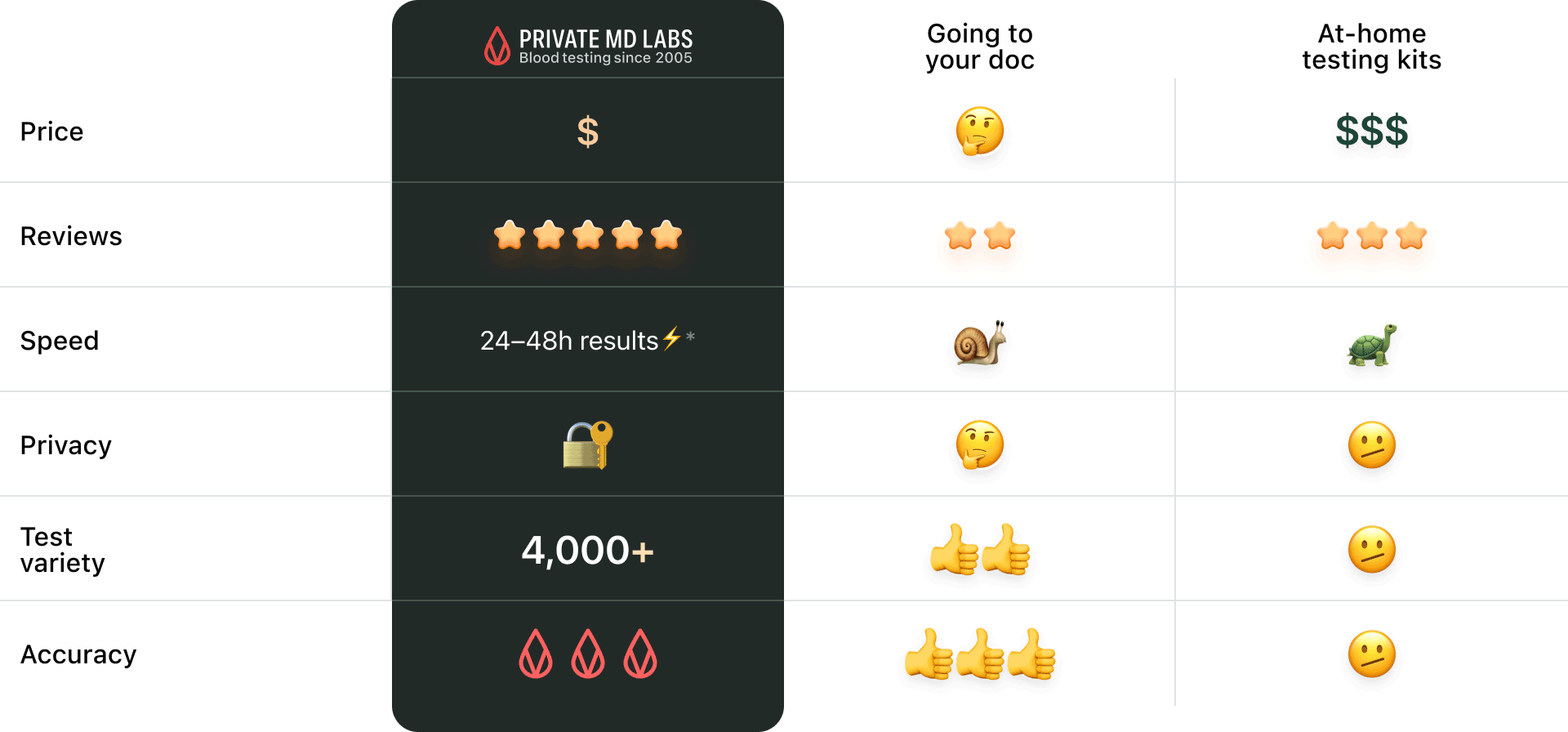
Us vs. Them
Not overhyped or overpriced. Just comprehensive blood testing made simple and for everyone.
* Regular blood test results (e.g., CBC) typically start arriving the next business day after sample collection. More complex tests, such as hormone panels, may take up to 10–15 business days due to their complexity.
1,000,000+ blood tests later, here's what our customers say
Estradiol Ultrasensitive results may get delayed due to high lab volume.It’s a nationwide delay affecting all labs (not just us). Standard processing times apply to all other tests in this panel.
Lipoprotein extended turnaround
Lipoprotein Fractionation, Ion Mobility results may get delayed due to high lab volume.It’s a nationwide delay affecting all labs (not just us). Standard processing times apply to all other tests in this panel.
Pregnenolone extended turnaround
Pregnenolone results may get delayed due to high lab volume.It’s a nationwide delay affecting all labs (not just us). Standard processing times apply to all other tests in this panel.



 90-day money-back guarantee
 Lab order in minutes
 Save a trip to the doctor
 Low prices since 2005
 Labs within 2 miles