Malignant hyperthermia is a rare, life-threatening genetic reaction to certain anesthesia drugs that causes rapid increase in body temperature and severe muscle rigidity. It is caused by mutations in genes controlling calcium release in muscle cells, triggered by volatile anesthetics like sevoflurane or the muscle relaxant succinylcholine. The Suxamethonium IgE test is the most important screening test for identifying allergies to succinylcholine, helping assess potential risk before surgery.
90-day money-back guaranteeLab order in minutesSave a trip to the doctorLow prices since 2005Labs within 2 miles
What causes malignant hyperthermia?
Malignant hyperthermia is caused by genetic mutations in the RYR1 or CACNA1S genes that control calcium release in muscle cells. When people with these mutations are exposed to certain anesthesia drugs like sevoflurane, desflurane, isoflurane, or the muscle relaxant succinylcholine, their muscles release excessive calcium, leading to severe muscle contractions, dangerously high fever, and potentially fatal complications. This inherited condition runs in families, so anyone with a family history of malignant hyperthermia reactions should inform their anesthesiologist before any surgery requiring general anesthesia.
What is the best test for malignant hyperthermia?
The Suxamethonium IgE test is the most important blood screening test for malignant hyperthermia risk because it detects allergic antibodies to succinylcholine, a common anesthesia drug that can trigger reactions. Elevated IgE levels indicate an allergy to this medication, and people with such allergies may have increased risk during surgery. However, the gold standard for diagnosing malignant hyperthermia susceptibility is the caffeine halothane contracture test, a specialized muscle biopsy procedure performed at specific medical centers. Genetic testing for RYR1 and CACNA1S gene mutations can also identify inherited risk. The IgE blood test serves as an accessible screening tool to identify potential anesthesia drug sensitivities before surgical procedures.
When should I get tested for malignant hyperthermia?
You should get tested if you have a family history of malignant hyperthermia or unexplained deaths during surgery, if you or a family member experienced muscle rigidity or extremely high fever during anesthesia, or if you are planning surgery and have unexplained muscle weakness or periodic episodes of muscle breakdown. Testing is especially important before any elective surgery requiring general anesthesia, so your anesthesiologist can plan safe alternatives and have emergency medications like dantrolene available. Early identification of risk can be lifesaving, as malignant hyperthermia reactions can occur within minutes of anesthesia exposure.
What are the symptoms of malignant hyperthermia?
Malignant hyperthermia symptoms develop rapidly during or shortly after anesthesia and include dangerously high body temperature rising as much as 2 degrees every 5 minutes, severe muscle rigidity especially in the jaw, rapid or irregular heartbeat, excessive sweating, mottled or discolored skin, rapid breathing, and dark brown urine indicating muscle breakdown. Other warning signs include rising carbon dioxide levels detected on monitoring equipment, low oxygen levels, and metabolic acidosis. Without immediate treatment with the medication dantrolene, symptoms can progress to kidney failure, internal bleeding, heart failure, and death within hours.
Who is at risk for malignant hyperthermia?
People with a family history of malignant hyperthermia are at highest risk, as the condition follows an autosomal dominant inheritance pattern where each child of an affected parent has a 50% chance of inheriting the mutation. Individuals with certain muscle disorders like central core disease, multiminicore disease, or King-Denborough syndrome have increased susceptibility. Men are affected more frequently than women, and most reactions occur in children and young adults during their first or second anesthesia exposure. Anyone with unexplained muscle weakness, elevated creatine kinase levels, or a history of heat stroke during exercise should be evaluated for malignant hyperthermia susceptibility before surgery.
What happens if malignant hyperthermia is left untreated?
Untreated malignant hyperthermia is fatal in approximately 70-80% of cases, with death occurring within hours of onset. The extreme muscle breakdown releases massive amounts of potassium into the bloodstream, causing dangerous heart rhythm abnormalities and cardiac arrest. Severe hyperthermia damages proteins throughout the body, leading to brain damage, liver failure, and widespread organ dysfunction. Muscle cell destruction causes acute kidney failure from myoglobin blockage, while blood clotting abnormalities lead to uncontrolled bleeding. Even with treatment, delayed recognition and intervention increase the risk of permanent complications including brain damage, kidney damage requiring dialysis, and muscle weakness.
Can malignant hyperthermia be diagnosed with a blood test?
Malignant hyperthermia cannot be definitively diagnosed with routine blood tests alone, but blood testing plays an important supportive role. The Suxamethonium IgE test can identify allergies to succinylcholine, indicating potential increased risk during anesthesia. Genetic blood tests can detect mutations in the RYR1 and CACNA1S genes associated with malignant hyperthermia susceptibility in about 70% of affected families. The definitive diagnostic test remains the caffeine halothane contracture test, which requires a muscle biopsy and specialized laboratory analysis. Elevated creatine kinase levels in routine blood work may suggest underlying muscle abnormalities and warrant further evaluation for malignant hyperthermia susceptibility, especially in people with family history or concerning symptoms.
How is malignant hyperthermia treated?
Malignant hyperthermia is treated immediately with the medication dantrolene, which stops calcium release in muscle cells and reverses the life-threatening reaction. The anesthesia team discontinues all triggering anesthetic agents, increases oxygen delivery, and cools the body using ice packs, cold intravenous fluids, and cooling blankets. Doctors monitor and treat complications including abnormal heart rhythms with medications, metabolic acidosis with sodium bicarbonate, and kidney protection with intravenous fluids and diuretics. Patients require intensive care monitoring for at least 24 hours after symptoms resolve, as reactions can recur. People diagnosed with malignant hyperthermia susceptibility can safely undergo surgery using alternative anesthetics like propofol and avoiding triggering drugs entirely.
How can I prevent malignant hyperthermia?
You can prevent malignant hyperthermia reactions by informing all healthcare providers, especially anesthesiologists, about personal or family history of the condition before any surgery or procedure requiring anesthesia. Wear a medical alert bracelet indicating malignant hyperthermia susceptibility so emergency personnel have this critical information. Request genetic counseling and testing if you have a family history, as early identification allows for safe anesthetic planning. Ensure your surgical team uses non-triggering anesthetics like propofol, ketamine, and opioids while avoiding volatile anesthetics and succinylcholine. Keep detailed family medical records documenting any adverse anesthesia reactions, and consider having family members tested if you are diagnosed with susceptibility.
What can I do at home for malignant hyperthermia?
Malignant hyperthermia is a medical emergency that occurs only during anesthesia exposure and requires immediate hospital treatment, so there are no home remedies for active reactions. However, you can take important steps at home to protect yourself, including maintaining detailed family health records documenting any anesthesia complications, keeping copies of genetic test results and malignant hyperthermia diagnostic testing easily accessible, and registering with the Malignant Hyperthermia Association of the United States for educational resources and support. Educate family members about the hereditary nature of the condition and encourage them to get tested. Before any dental procedures or surgeries, confirm that your healthcare team is aware of your susceptibility and has dantrolene available, as preparation and awareness are your best protection.
How’s this work?
Getting your blood test with us is easy, private & backed by the power of science.
Long story short:
In the test options, use the filters or search box to narrow your choices and find the test you want.
If you need a hand navigating through options, text our super friendly support team at 754-799-7833, and we'll provide tailored suggestions to help you find the ideal test.
Once your order is placed, we’ll create your doctor’s lab order remotely, without any need for you to make a trip to a doctor in person or to talk to the doctor. Expect to receive your doctor’s lab order right in your inbox. It will also be in your patient portal if you need to find it later. We’ll also include instructions regarding fasting and other requirements for your test. Your patient portal will be auto-created hassle-free during checkout.
If this is your first time ordering, you'll be prompted to create a password for instant login access to your patient portal. It's a quick way to conveniently access your orders and results whenever you want.
When you’re ready, visit one of our 4,000 locations. Just bring your ID – no printing or faxing of your lab order is needed, as your order and details will already be in the lab system.
Note that most lab locations don’t accept walk-ins, so it’s best to book an appointment in advance. Don’t worry – we’ll provide detailed instructions along the way.
You’ll get your results via email & SMS and dive into understanding your body better. Yup, that easy!
If you have any questions, please text us at 754-799-7833 or email support@privatemdlabs.com and we'll gladly help you.
How do I know which test to get?
In the test options, find the test you want.
If you’re not sure which test to get, we can lend a hand in finding the right option.
Just text or call us at 754-799-7833, email us at support@privatemdlabs.com, and we'll gladly help you. We've got your back and reply quickly.
Is it possible to make changes to my lab order if I made a mistake with the name, date of birth, or any other details?
Absolutely! We totally understand that errors can happen. No worries, we're here to help you.
Just reach out to us via text at 754-799-7833 or shoot us an email at
support@privatemdlabs.com. Remember to include your order number and let us know the correct information you’d like to update.
Our awesome team will jump right in and make sure everything is sorted out and accurate for you.
There are no changes necessary if your address is wrong on the requisition though. We don’t mail anything out.
Our lab requires an address to be listed to generate an order.
Do you accept health insurance?
Only HSA & FSA is accepted.
Our services are strictly self-pay and cannot be submitted to your health insurance provider except for Health Savings Accounts or Flexible Savings Accounts.
This policy applies to all insurance companies, including federal health insurance programs like Medicare.
You can read more about our cancellation policy here.
How can I find a lab location near me?
During the ordering process, you’ll be able to select a specific lab near you, with no strings attached!
You can switch it up later easily and visit any of our authorized locations as long as it’s the same lab company you selected your test for (Quest Diagnostics or Labcorp).
Before you proceed with your order, feel free to browse through all our lab locations here. This will give you the peace of mind of knowing that there's a lab nearby your home, office or your favorite gym.
Here’s how easy it is to get blood work done on your terms
Order your testSave a trip to the doctor. Your results will come with clear, friendly explanations.Takes 2 minutes
Book an appointmentVisit any of our 4,000 nearby lab locations to have your samples collected.Book or walk-in
Get resultsReceive a clear, easy-to-digest health report by email & SMS within a few business days.Get answers, fast
Here’s why 1,000,000+ customers chose us for affordable hassle-free private blood testing.
You get clinical lab reports & simplified health insights.
Save time & gas, go straight to the lab. Our doctors cover the rest.
Results start landing the next day after your lab visit.*
We don’t sell or share your data. Your time & privacy matter.
US-licensed doctors have your back if things get unclear.
No hidden fees, nice discounts for regular checkups.
Save a trip to the doctor, go directly to the lab
Instant orders, results often overnight*
Results explained in simple language
Reviewed by US licensed doctors
Fast & confidential, we never sell or share your data
No insurance needed, transparent pricing
Demo results
Testosterone375 ng/dL
Demo results
NormalOptimal 400 - 1000High
375 ng/dL
What this means
Your testosterone levels are slightly below the optimal range. While this is not necessarily cause for concern, it may contribute to occasional fatigue, reduced motivation, or lower muscle mass over time.
Recommended actions
Increase resistance or strength training
Prioritize 7–8 hours of quality sleep per night, try to reduce stress
Include more zinc- and magnesium-rich foods (like shellfish, beef, pumpkin seeds, spinach)
Consider retesting in 3–6 months
* Regular blood test results (e.g., CBC) typically start arriving the next business day after sample collection. More complex tests, such as hormone panels, may take up to 10–15 business days due to their complexity.
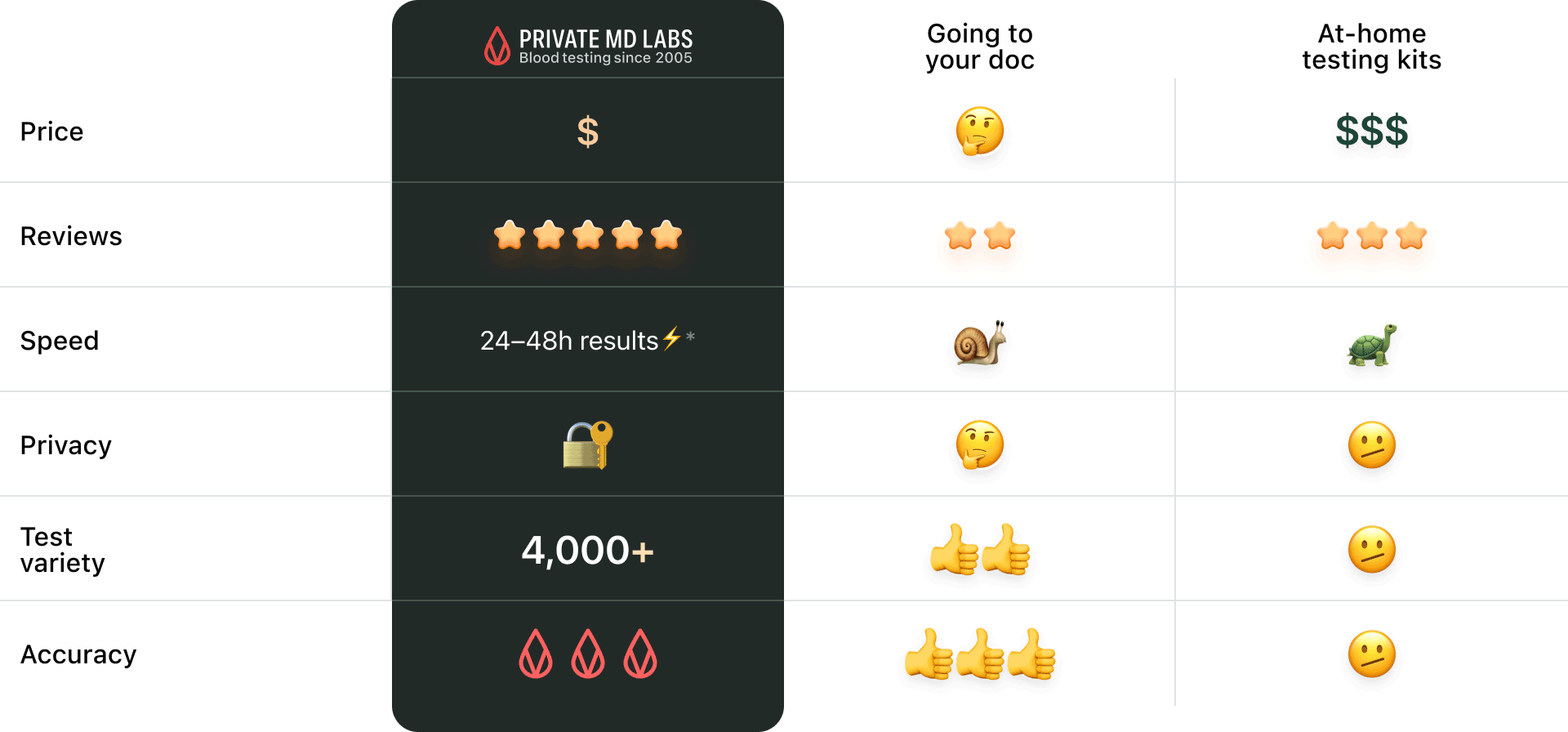
Us vs. Them
Not overhyped or overpriced. Just comprehensive blood testing made simple and for everyone.
* Regular blood test results (e.g., CBC) typically start arriving the next business day after sample collection. More complex tests, such as hormone panels, may take up to 10–15 business days due to their complexity.
1,000,000+ blood tests later, here's what our customers say
Estradiol Ultrasensitive results may get delayed due to high lab volume.It’s a nationwide delay affecting all labs (not just us). Standard processing times apply to all other tests in this panel.
Lipoprotein extended turnaround
Lipoprotein Fractionation, Ion Mobility results may get delayed due to high lab volume.It’s a nationwide delay affecting all labs (not just us). Standard processing times apply to all other tests in this panel.
Pregnenolone extended turnaround
Pregnenolone results may get delayed due to high lab volume.It’s a nationwide delay affecting all labs (not just us). Standard processing times apply to all other tests in this panel.



 90-day money-back guarantee
 Lab order in minutes
 Save a trip to the doctor
 Low prices since 2005
 Labs within 2 miles